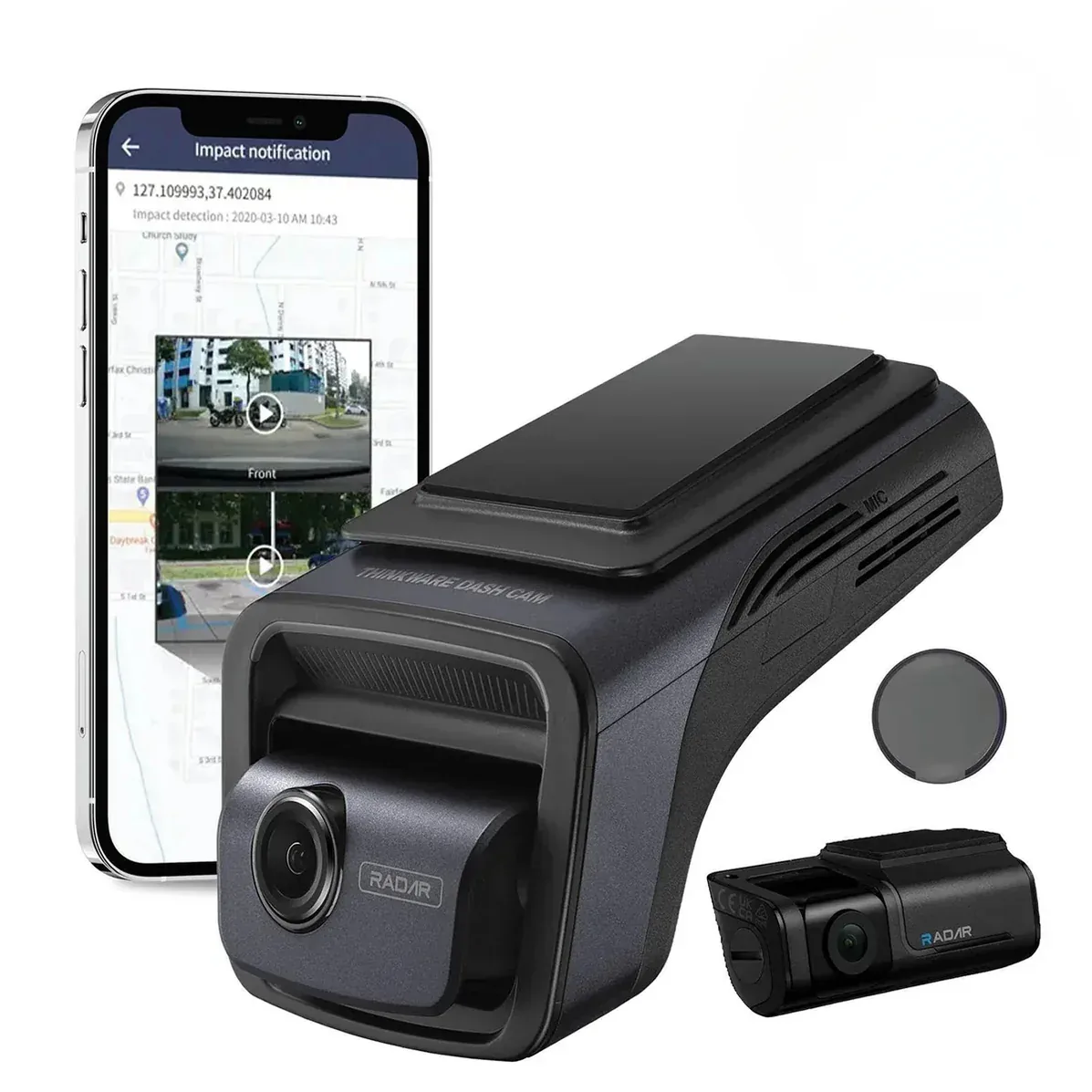
Thinkware U3000 2CH
No rating shown: we have no owner rating for this camera from a source we can cite. Why
Radar built into the body is unique to the U3000 in this catalog, and that single component is what the whole product is organised around. A conventional parking mode either records continuously - which drains a car battery in a day - or waits for a G-sensor hit, which means the approach is never recorded. Radar lets the camera sleep at very low draw while still noticing that something is moving near the car, and wake before anything touches it. Thinkware calls this Energy Saving Parking Mode 2.0, and a free OBD power cable is in the box so it works without a fuse-box install. The cameras are an 8MP Sony STARVIS 2 IMX678 front at 3840x2160 on a 158-degree lens, and a 5MP IMX335 rear at 2560x1440 on an unusually narrow 128-degree lens, with dual HDR. A CPL filter is included. The limits are a 256GB card ceiling, a 14 to 140 degree Fahrenheit operating range that is the narrowest here, and the fact that every cloud feature needs an LTE module and a plan.
- Approx. price
- ~$550
- Hot car
- Supercapacitor
- Supercapacitor, rated to 140°F
- Parking tier
- Radar-buffered
- Hardwire kit included
Parking surveillance that has to catch the approach, not just the impact.
The description and the pros and cons above are written from published specifications, not from owner reports. Owner sentiment, where we have it, is in its own section below.
What the numbers mean here
The front camera records 3,840 horizontal pixels across a published 158-degree field of view, which is 24.3 pixels per degree — plate-legible a few lengths ahead. The rear channel manages 20, so it is the less detailed of the two. How this is calculated, and what it does not tell you.
It runs on a supercapacitor rather than a lithium cell, so there is no battery to swell in a car parked in summer sun — the classic way a windshield-mounted camera dies. The maker publishes an operating range of 14°F to 140°F. Supercapacitors and heat.
Radar notices movement near the car and wakes the camera before anything touches it, so the approach is recorded without leaving the camera running all night. The hardwiring cable is in the box, so this works from the first install. What each parking mode records.
Specifications
Manufacturer-published figures, recorded from Thinkware’s own product page and a specialist retailer’s spec table. Fields the maker does not publish are omitted rather than guessed.
- Type
- Dual-channel
- Channels
- 2
- Front resolution
- 2160p
- Front frame rate
- 30fps
- Front sensor
- Sony STARVIS 2 IMX678
- Front field of view
- 158° (as published)
- Rear resolution
- 1440p
- Rear sensor
- Sony STARVIS IMX335
- HDR
- dual-exposure HDR
- Power cell
- Supercapacitor
- Operating temperature
- 14°F to 140°F
- Parking modes
- buffered, time-lapse, radar, motion
- Hardwire kit
- included
- GPS
- built-in
- Wi-Fi
- 5 GHz
- LTE / cloud
- Supported
- Max storage
- 256GB microSD
- CPL filter
- included
- Screen
- None
- Voice control
- No
- Form factor
- wedge
- Mount
- adhesive
- Release year
- 2024
These features need an active paid plan on top of the hardware: remote live view, cloud backup, GPS tracking.
Features
- Built-in radar module for motion-triggered parking surveillance
- Energy Saving Parking Mode 2.0 with radar wake
- Front 4K on a Sony STARVIS 2 IMX678, rear 1440p on a narrow 128-degree lens
- Dual HDR across both channels
- OBD power cable and CPL filter included in the box
- Built-in 5GHz Wi-Fi, Bluetooth and GPS; cloud via an optional LTE module
- Supercapacitor power
Where it is strong
- Radar is the only parking technology here that records what happened before contact without leaving the camera running all night
- An OBD power cable in the box means parking mode works without touching a fuse box
- A 128-degree rear lens is narrower than anything else here and concentrates 1440p where a rear plate actually is - about 20 px per degree
- CPL filter included rather than a thirty-dollar upsell
- Dual HDR on both channels and a supercapacitor power system
Where it gives way
- 256GB card ceiling is restrictive for 4K plus 1440p and cannot be extended
- 14 to 140 degrees Fahrenheit is the narrowest published operating range in this catalog - the low end in particular is poor for a cold climate
- The 158-degree front lens spreads 4K to about 24 px per degree, behind the 140-degree 4K cameras
- Expensive, and every cloud feature still needs an LTE module plus a subscription
- No voice control
What owners say
Summarised from public owner discussion. Nothing here is our own testing.
The U3000 is bought for its parking mode and owners are clear-eyed that this is the whole argument. Radar wakes the camera before something touches the car rather than after, and the OBD-II cable in the box means you can have that without touching a fuse box - which is the easiest parking-mode setup of anything in this catalog.
The number owners actually measure is less flattering. In energy-saving parking mode, roughly ten percent of a car battery goes overnight, which works out to about ten days of unattended parking before the car will not start. Owners who need more fit an external battery pack, and several bought the camera and the battery together on that advice.
The operational complaint is odd and specific: the camera drops into parking mode seconds after a phone connects, killing its own Wi-Fi and making the app unusable. Owners have tried resets without success. Add to that a card-compatibility story that pushes toward Thinkware's own branded cards, and no SIM slot for cloud, and there is more friction here than the price suggests.
What owners like
- The radar parking mode is what owners buy it for, and it is the reason it wins against cheaper rivals in their own shortlists
- The free OBD-II power cable in the box means parking mode works without a fuse-box install, which owners rate as the easiest parking setup in the category
- Owners report Thinkware turning a warranty replacement around in about two days, including replacing a CPL filter that came with the original unit
- Owners who prioritise parking coverage over everything else consistently name it as the model they chose
Common complaints
- Even in energy-saving parking mode owners measure roughly ten percent of car battery overnight, which puts a practical ceiling on unattended parking of about ten days
- The camera drops into parking mode within seconds of a phone connecting over the app, disabling its own Wi-Fi and making the app effectively unusable
- One owner returned theirs after finding the footage choppy with and without the CPL filter, and nothing like the demonstrations they had seen
- It has no SIM slot, so cloud connectivity needs a separate Wi-Fi device in the car - which owners find out after buying
- Card compatibility guidance is thin, with Thinkware recommending its own branded cards and owners left unsure whether a premium endurance card will work
What owners of the Thinkware U3000 2CH ask
How much battery does parking mode use overnight?
Why does the camera go into parking mode while I am using the app?
Do I need the radar?
Can it connect to the cloud?
Does it have to be a Thinkware-branded card?
Compare the U3000 2CH
Similar cameras
Thinkware U1000
- Front px/°
- 25.6
- Front
- 2160p/30
- 150° lens
Thinkware ARC900
- Front px/°
- 26.1
- Front
- 2160p/30
- 147° lens
Thinkware Q1000
- Front px/°
- 16.4
- Front
- 1440p/30
- 156° lens