Vantrue Nexus 5
No rating shown: we have no owner rating for this camera from a source we can cite. Why
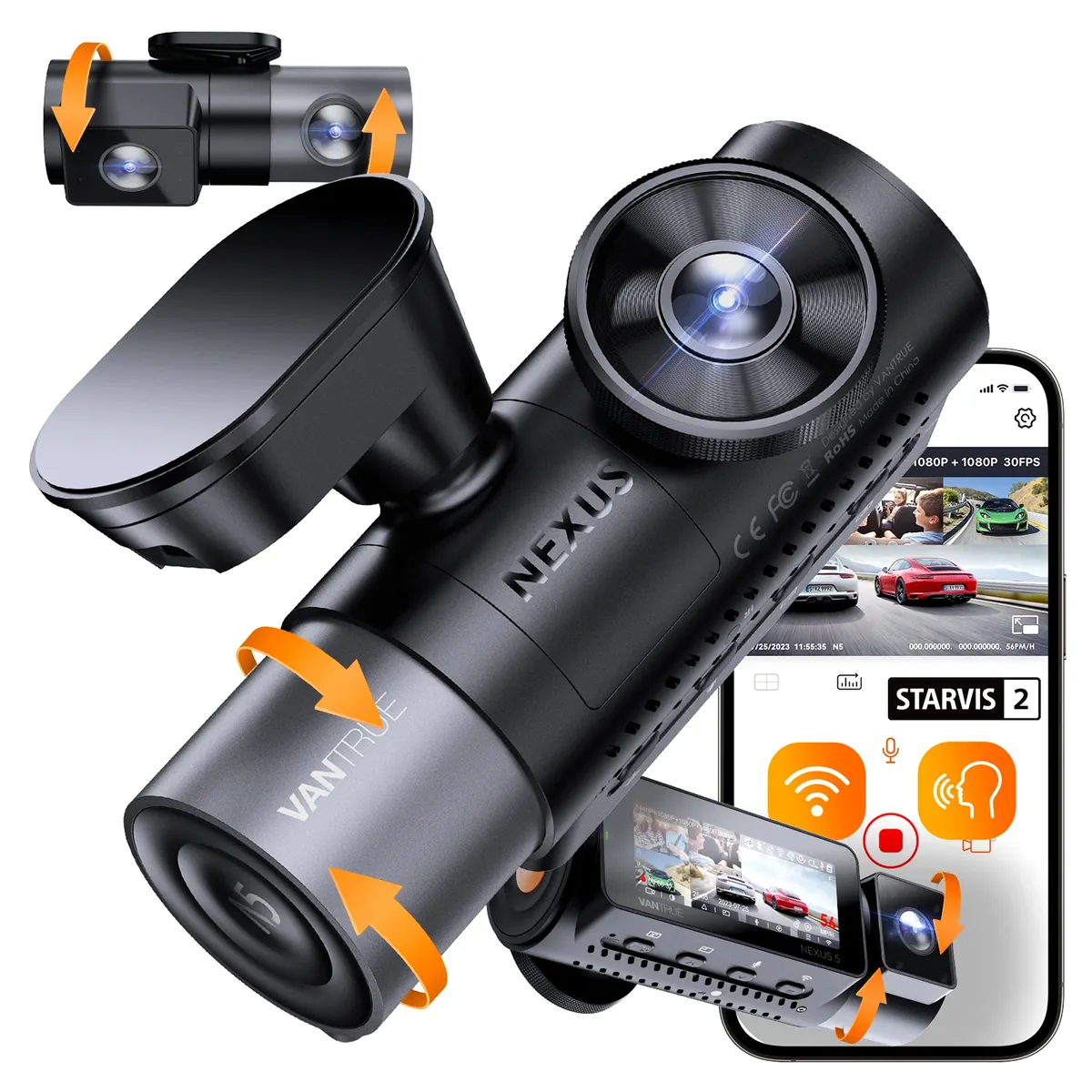
Four cameras in one body puts the Nexus 5 in a category of one in most catalogs. Front is 2592x1944 on a Sony STARVIS 2 IMX675 at 158 degrees; then there are two interior cameras - a front cabin view at 160 degrees and a rear cabin view at 160 degrees, both with four infrared LEDs - and a rear road camera at 165 degrees. The point of two cabin cameras is a full-size vehicle: in a minivan or a three-row SUV a single dash-mounted cabin lens shows you the front seats and a blur where the third row is. For a rideshare driver working an XL queue, that is the whole argument. It costs you in the obvious places: four streams on one card, a longer install with more cable to hide, and a front channel that stops at 1944p rather than 4K. Supercapacitor power rated -4 to 140 degrees Fahrenheit, 1TB card support, 5GHz Wi-Fi, built-in GPS and voice control are standard, and parking modes need a hardwire kit sold separately.
- Approx. price
- ~$300
- Hot car
- Supercapacitor
- Supercapacitor, rated to 140°F
- Parking tier
- Buffered
- Hardwire kit optional
Large vehicles where one cabin camera cannot see the back rows.
The description and the pros and cons above are written from published specifications, not from owner reports. Owner sentiment, where we have it, is in its own section below.
What the numbers mean here
The front camera records 2,592 horizontal pixels across a published 158-degree field of view, which is 16.4 pixels per degree — plate-legible close in. The rear channel manages 11.6, so it is the less detailed of the two. How this is calculated, and what it does not tell you.
It runs on a supercapacitor rather than a lithium cell, so there is no battery to swell in a car parked in summer sun — the classic way a windshield-mounted camera dies. The maker publishes an operating range of -4°F to 140°F. Supercapacitors and heat.
Keeps a rolling buffer, so the seconds before an impact are saved as well as the impact itself. It is the most useful parking mode and the hungriest. The hardwire kit is a separate purchase, which is the line item people forget when budgeting. What each parking mode records.
Specifications
Manufacturer-published figures, recorded from Vantrue’s own product page and a specialist retailer’s spec table. Fields the maker does not publish are omitted rather than guessed.
- Type
- Triple-channel
- Channels
- 4
- Front resolution
- 1944p
- Front frame rate
- 30fps
- Front sensor
- Sony STARVIS 2 IMX675
- Front field of view
- 158° (as published)
- Front aperture
- f/1.8
- Rear resolution
- 1080p
- Rear sensor
- Sony STARVIS
- Interior resolution
- 1080p
- HDR
- HDR
- Power cell
- Supercapacitor
- Operating temperature
- -4°F to 140°F
- Parking modes
- buffered, time-lapse, low-bitrate, motion
- Hardwire kit
- optional
- GPS
- built-in
- Wi-Fi
- 5 GHz
- LTE / cloud
- None
- Max storage
- 1024GB microSD
- CPL filter
- optional
- Screen
- 2.45-inch
- Voice control
- Yes
- Form factor
- wedge
- Mount
- adhesive
- Release year
- 2023
Features
- Four cameras: front road, front cabin, rear cabin and rear road
- Infrared LEDs on both cabin channels
- Sony STARVIS 2 IMX675 front sensor with WDR
- 5GHz Wi-Fi, built-in GPS logger, voice control, optional remote
- Supercapacitor, -4 to 140 degrees Fahrenheit
- microSD to 1TB
Where it is strong
- Two cabin cameras genuinely cover a three-row vehicle, which a single dash-mounted lens does not
- Infrared on both interior channels, so the rear rows record with the lights off
- 1TB card support, which four streams badly need
- Supercapacitor power on a camera aimed at drivers who park in the sun all day
Where it gives way
- Four streams on a single card give the shortest loop of anything in this catalog
- Front channel stops at 1944p on a 158-degree lens - about 16 px per degree, which is modest for the price
- Both cabin cameras and the rear road camera are 1080p
- The install is the longest here: four camera positions and three cable runs
- No LTE option, so nothing is monitored remotely
What owners say
Summarised from public owner discussion. Nothing here is our own testing.
The Nexus 5 exists for one reason and owners buy it for that reason: a second interior camera aimed at the back of the cabin, which is the only way to actually see a third row or the rear seats of a large vehicle. For rideshare drivers working larger vehicles it is close to the only option.
Three complaints are specific enough to weigh before buying. Wi-Fi conflicts are the worst: owners with a car hotspot or a phone VPN active find the app cannot see the camera, and get disconnected repeatedly. The rear cabin camera is described as unclear at night, with owners suspecting the infrared illumination is reflecting off the headliner when the unit is mounted high. And at least one owner reports a daily 'slow card' warning that stops recording, which is the failure that makes the whole purchase pointless.
The volume problem is real too. Four channels produce a lot of footage on one card, with no cloud to triage it, so finding a specific moment means scrubbing.
What owners like
- The only practical answer owners find when they need cabin coverage of a back row as well as the front seats
- Owners who had it professionally hardwired after vandalism report it doing the job they bought it for
- Four supercapacitor-powered channels at a price that owners compare favourably with adding a second camera
- Owners moving between work vehicles like that it can be unmounted and taken along at the end of a shift
Common complaints
- Wi-Fi conflicts are the loudest complaint - the camera is not recognised by the app when the car's own Wi-Fi or a phone VPN is active, and owners get kicked out of the app repeatedly
- The rear cabin camera is described as unclear at night, with owners suspecting the infrared is bouncing off the headliner when the camera is mounted high
- 'Slow card' warnings that stop recording are reported daily by at least one owner, which is the failure mode that makes a camera useless
- Four channels on one card means owners have to review a lot of footage to find anything, and there is no cloud path on this model
- Owners who mount it in a work truck find the wiring hard to hide and visible enough to draw attention
What owners of the Vantrue Nexus 5 ask
Why can't the app see the camera?
Why is the rear cabin camera so dark at night?
What does the 'slow card' message mean?
Will it drain my battery if I leave the car for two weeks?
Compare the Nexus 5 (N5)
Similar cameras
Vantrue Nexus 4 Pro S
- Front px/°
- 24.8
- Front
- 2160p/30
- 155° lens
Vantrue Nexus 4S
- Front px/°
- 16.4
- Front
- 1944p/30
- 158° lens
Vantrue Nexus 4 Pro
- Front px/°
- 24.8
- Front
- 2160p/30
- 155° lens