Viofo A119 Mini 2
No rating shown: we have no owner rating for this camera from a source we can cite. Why
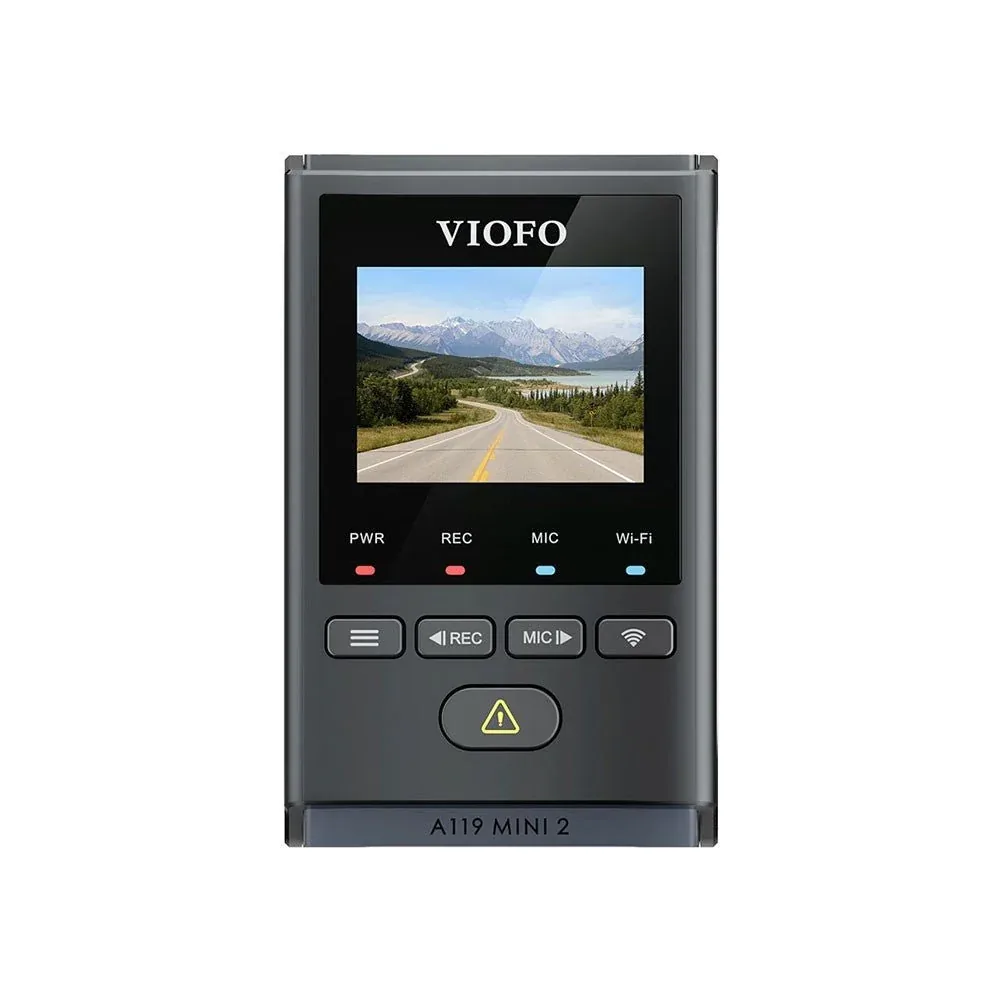
The A119 Mini 2 is the camera most people who ask for "something small that just records" end up with. It is a stubby wedge that hides behind a rearview mirror, it has a 1.5-inch screen for aiming and menus rather than for watching video, and it records 2560x1440 at 60fps on a Sony STARVIS 2 IMX675 through an f/1.6 lens quoted at 140 degrees. The 60fps matters more than the resolution jump on a dash cam: at highway closing speeds, a plate that smears across two frames at 30fps often lands clean on one at 60. HDR is available at 30fps if you would rather have the exposure latitude than the frame rate, and the menu makes you choose. Power comes from a supercapacitor, so there is no lithium cell to swell in a car that bakes at a summer trailhead, and Viofo rates it from -4 to 149 degrees Fahrenheit. GPS, Bluetooth, 5GHz Wi-Fi and voice control are all built in. Parking modes need the HK4 hardwire kit, which is a separate purchase, and that is the one line item people forget when they budget for this camera.
- Approx. price
- ~$160
- Hot car
- Supercapacitor
- Supercapacitor, rated to 149°F
- Parking tier
- Buffered
- Hardwire kit optional
A first dash cam that disappears behind the mirror and still resolves plates at speed.
The description and the pros and cons above are written from published specifications, not from owner reports. Owner sentiment, where we have it, is in its own section below.
What the numbers mean here
The front camera records 2,560 horizontal pixels across a published 140-degree field of view, which is 18.3 pixels per degree — plate-legible close in. There is no rear channel on this model. How this is calculated, and what it does not tell you.
It runs on a supercapacitor rather than a lithium cell, so there is no battery to swell in a car parked in summer sun — the classic way a windshield-mounted camera dies. The maker publishes an operating range of -4°F to 149°F. Supercapacitors and heat.
Keeps a rolling buffer, so the seconds before an impact are saved as well as the impact itself. It is the most useful parking mode and the hungriest. The hardwire kit is a separate purchase, which is the line item people forget when budgeting. What each parking mode records.
Specifications
Manufacturer-published figures, recorded from Viofo’s own product page and a specialist retailer’s spec table. Fields the maker does not publish are omitted rather than guessed.
- Type
- Single-channel
- Channels
- 1
- Front resolution
- 1440p
- Front frame rate
- 60fps
- Front sensor
- Sony STARVIS 2 IMX675
- Front field of view
- 140° (as published)
- Front aperture
- f/1.6
- HDR
- HDR
- Power cell
- Supercapacitor
- Operating temperature
- -4°F to 149°F
- Parking modes
- buffered, time-lapse, low-bitrate, motion
- Hardwire kit
- optional
- GPS
- built-in
- Wi-Fi
- 5 GHz
- LTE / cloud
- None
- Max storage
- 512GB microSD
- CPL filter
- optional
- Screen
- 1.5-inch
- Voice control
- Yes
- Form factor
- wedge
- Mount
- adhesive
- Release year
- 2023
Features
- 2560x1440 at 60fps, or 1440p HDR at 30fps
- Sony STARVIS 2 IMX675 behind an f/1.6 seven-element glass lens
- Supercapacitor power, rated -4 to 149 degrees Fahrenheit
- Buffered, time-lapse, low-bitrate and motion parking modes with the HK4 kit
- 5GHz Wi-Fi, Bluetooth remote support, built-in GPS logger
- Voice commands for lock, photo, Wi-Fi and microphone
- microSD cards up to 512GB
Where it is strong
- 60fps at 1440p is the single most useful thing at this price - fast-moving plates land on a clean frame instead of smearing across two
- Genuinely small: the body hides behind a standard rearview mirror with no mirror-edge overhang
- Supercapacitor rather than a lithium cell, so hot-climate parking does not shorten its life
- Sony STARVIS 2 sensor is the same generation as cameras costing twice as much
- 5GHz Wi-Fi moves a one-minute 1440p clip to a phone in seconds rather than minutes
Where it gives way
- HDR and 60fps are mutually exclusive - you pick one in the menu and live with it
- Parking mode needs the HK4 hardwire kit, which is an extra purchase and an extra install
- The 1.5-inch screen is for aiming and menus, not for reviewing footage in any detail
- No rear channel at all, and no way to add one later
What owners say
Summarised from public owner discussion. Nothing here is our own testing.
This is the camera owners recommend to people who ask for "something small that just works", and the praise is unusually consistent about why: the body hides behind a mirror, the 60fps mode holds plates that older cameras smeared, and the 5GHz Wi-Fi makes pulling a clip a thirty-second job rather than a chore.
Two things go wrong here, and neither is image quality. The first is a freeze after parking mode, where the camera goes unresponsive until it is power-cycled; owners who chased it down point at the power plug and cable rather than the camera itself, and reseating or replacing the cable fixes it for some. The second is the G-sensor, which arrives sensitive enough that ordinary acceleration locks clips and slowly fills the card with protected files. Turning it down is the first thing experienced owners tell new ones to do.
The other practical note is storage. At 1440p60 a 256GB card does not survive a long drive, and owners doing multi-day trips either drop the bitrate or offload to a laptop each night. Budget for the HK4 hardwire kit and a large high-endurance card at purchase rather than later.
What owners like
- Owners consistently say it looks and performs like reviews promised, which is not the norm at this price
- The size is the thing people mention first - it genuinely disappears behind a rearview mirror, and several owners bought it specifically because a bigger camera was too visible from outside
- The 60fps mode gets credited for plates that earlier 30fps cameras smeared
- Owners moving up from an A119 V3 describe the 5GHz Wi-Fi as the single biggest quality-of-life change
- Widely bought as a pair with a CPL filter and the HK4 hardwire kit for around the price of one older two-channel camera
Common complaints
- The most-reported fault is a freeze after a spell in parking mode - the camera becomes unresponsive and needs a power cycle, and owners who traced it blamed the power plug and cable contacts rather than the camera
- The 2.4GHz half of the Wi-Fi radio fights with Android Auto and Bluetooth in some cars; owners work around it by only enabling the camera's Wi-Fi after the phone has connected
- A recurring complaint is the camera dropping into a double-beep state and stopping recording, which survives card reformats and factory resets for some owners
- The G-sensor ships sensitive enough that hard acceleration or a pothole triggers 'video protected' and fills the locked-file folder, which then eats the card
- Loop clips come back at inconsistent lengths - owners set three minutes and get a mix of twelve-second and forty-second files
- A 256GB card is not enough for a long road trip at 1440p60, and owners on twelve-hour drives offload nightly to keep up
What owners of the Viofo A119 Mini 2 ask
Why does my A119 Mini 2 freeze after parking mode?
Does the Wi-Fi interfere with Android Auto?
Why is it constantly beeping and saying video protected?
How big a card does it need?
Do I need the hardwire kit?
Compare the A119 Mini 2
Similar cameras
Viofo VS1 Mini
- Front px/°
- 18.3
- Front
- 1440p/30
- 140° lens
Viofo A119 V3
- Front px/°
- 18.3
- Front
- 1600p/30
- 140° lens
Viofo A119M Pro
- Front px/°
- 27.4
- Front
- 2160p/30
- 140° lens